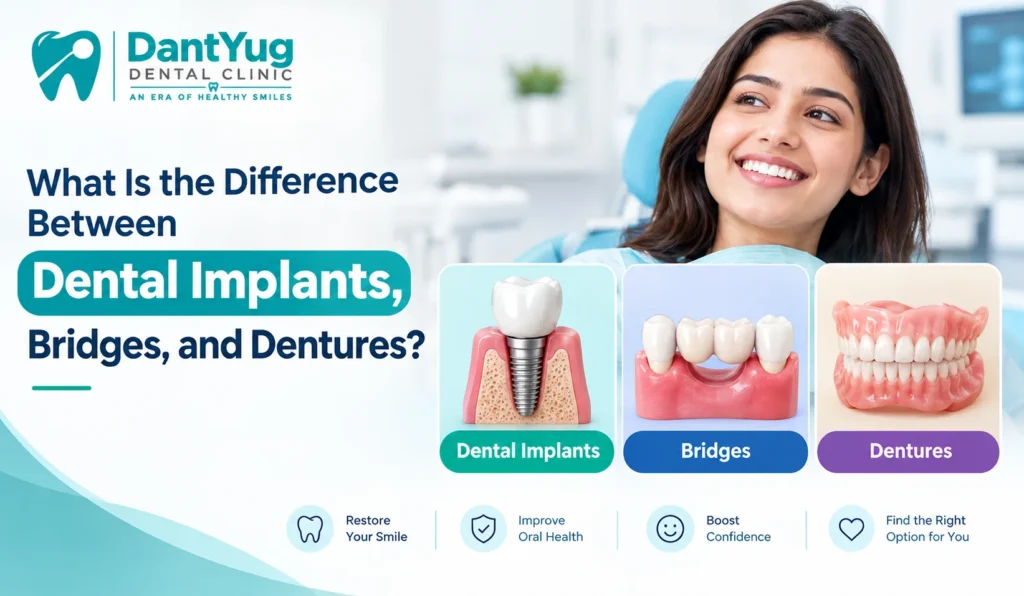
Missing teeth can affect more than your smile. They may make chewing difficult, affect your speech, and reduce your confidence. Whether you have lost one tooth, several teeth, or an entire set, choosing the right tooth replacement option is important for your oral health and everyday comfort.
Three commonly recommended solutions are dental implants, dental bridges, and dentures. Although all three replace missing teeth, they differ in how they are supported, how they are maintained, their treatment duration, and their long-term costs. At DantYug Dental Clinic, patients can discuss these options with a dentist and understand which treatments may suit their oral health needs.
The main difference is that dental implants are anchored in the jawbone, conventional dental bridges are supported by neighbouring teeth, and traditional dentures rest on the gums and are removable.
In this guide, we compare dental implants vs bridges vs dentures, including their benefits, disadvantages, costs, durability, comfort, maintenance, and suitability for different dental conditions.
Treatment time, costs, durability, and suitability vary by patient, materials, oral health, and the number of missing teeth.
What Are Dental Implants?
Dental implants are artificial tooth roots, usually made from titanium, that are surgically placed into the jawbone. After the implant integrates with the bone, a dental crown, bridge, or denture can be attached to restore missing teeth. A single dental implant can replace one missing tooth, while multiple implants may support a bridge or a full-arch restoration. Dental implants provide a stable foundation for replacement teeth and can closely resemble natural teeth in appearance and function. If you are considering this treatment locally, explore Dental Implants in Bavdhan to learn more about implant treatment, its benefits, and the factors that influence suitability. DantYug Dental Clinic can help you understand the assessment process and the questions to ask before choosing an implant.Advantages of Dental Implants
- Natural-looking results: Implant-supported crowns are customised to complement the colour and shape of surrounding teeth.
- Stable chewing function: Implants provide a secure foundation for replacement teeth.
- Support for jawbone health: Implants help maintain bone around the implant by transmitting chewing forces to the surrounding bone.
- Preservation of neighbouring teeth: A single implant usually does not require adjacent teeth to be reshaped.
- Long-term tooth replacement: With proper oral hygiene and professional care, implants can function for many years.
Disadvantages of Dental Implants
- Implant placement requires a surgical procedure.
- Treatment may take several months, depending on healing and the treatment plan.
- The initial cost is generally higher than that of conventional dentures.
- Some patients may need bone grafting or additional procedures.
- Certain medical conditions, smoking, poor oral hygiene, and inadequate bone support may affect suitability or healing.
What Is a Dental Bridge?
A dental bridge is a fixed dental restoration that replaces one or more missing teeth. A conventional tooth-supported bridge generally consists of artificial teeth attached to crowns placed over supporting teeth on either side of the gap. The replacement tooth is called a pontic, while the supporting teeth are known as abutment teeth. Dental bridges are often considered when a patient wants a fixed tooth replacement without undergoing implant surgery.Advantages of Dental Bridges
- Fixed replacement: A conventional bridge stays in place during everyday activities.
- Shorter treatment time: Treatment can often be completed within a few weeks, depending on the case.
- Improved appearance: A bridge can be matched to the colour and shape of surrounding teeth.
- Restored chewing ability: A properly designed bridge helps restore function.
- No implant surgery: Conventional bridges do not require surgical implant placement.
Disadvantages of Dental Bridges
- Supporting natural teeth usually need to be reshaped.
- Plaque and food debris can collect around or beneath the bridge.
- Special cleaning methods are needed to maintain gum health.
- The bridge may require repair or replacement over time.
- Bone loss may continue beneath the missing tooth because a conventional bridge does not replace the tooth root.
What Are Dentures?
Dentures are custom-made dental appliances that replace missing teeth. Traditional dentures are removable and can replace several teeth or all teeth in the upper or lower jaw. There are two main types of conventional dentures.1. Partial Dentures
Partial dentures replace some missing teeth when natural teeth remain. Depending on the design, they may use clasps or other attachments to improve retention and stability. They can be a practical option for people who need to replace several teeth without undergoing implant surgery.2. Complete Dentures
Complete dentures replace all teeth in the upper jaw, lower jaw, or both. They rest on the oral tissues and are designed to restore facial appearance, speech, and chewing function. Some patients may also be suitable for implant-supported dentures, which use dental implants to improve stability.Advantages of Dentures
- Suitable for multiple missing teeth: Dentures can replace several teeth or an entire arch.
- Lower initial cost: Conventional dentures are often more affordable upfront than implants.
- Non-surgical treatment: Traditional dentures generally do not require implant surgery.
- Customised design: Dentures are made to fit the mouth and complement facial features.
- Flexible options: Partial, complete, and implant-supported dentures offer different treatment possibilities.
Disadvantages of Dentures
- Traditional dentures may move or become loose while eating or speaking.
- Some patients need time to adjust to wearing them.
- Gum irritation and sore spots may develop.
- Dentures require daily cleaning and removal as instructed.
- Changes in the jawbone and gums can affect the fit over time.
- Conventional dentures do not provide the same direct jawbone stimulation as natural tooth roots or dental implants.
Dental Implants vs Bridges vs Dentures: Comparison Table
Understanding the differences between these tooth replacement treatments can help you prepare for a dental consultation.| Feature | Dental Implants | Dental Bridges | Dentures |
|---|---|---|---|
| Main purpose | Replace missing teeth using implants in the jawbone | Replace missing teeth using supporting teeth or suitable structures | Replace several or all missing teeth |
| Support | Jawbone through the implant | Usually neighbouring natural teeth | Gums and oral tissues, or implants for supported designs |
| Fixed or removable | Usually fixed for crowns and bridges | Usually fixed | Conventional dentures are removable |
| Surgery | Required for implant placement | Usually not required | Usually not required for conventional dentures |
| Treatment duration | Often several months | Often a few weeks | Varies with fitting and adjustments |
| Impact on adjacent teeth | Usually no reshaping for a single implant | Supporting teeth generally require preparation | Usually no crown preparation |
| Jawbone support | Helps preserve bone around the implant | Does not directly replace the tooth root | Conventional dentures do not prevent bone loss |
| Initial cost | Generally higher | Varies by materials and number of teeth | Generally lower for conventional dentures |
| Daily care | Brushing, interdental cleaning, and professional reviews | Careful cleaning around and beneath the bridge | Removal and cleaning of conventional dentures |
| Potential maintenance | Crown or other components may need attention | May need repair or replacement | May need adjustment, relining, or replacement |
Dental Implants vs Bridges: Which Is Better for a Missing Tooth?
When replacing a single missing tooth, dental implants and bridges are two common options. A dental implant supports a replacement crown without usually requiring neighbouring teeth to be reshaped. It may also help preserve bone around the implant. A conventional dental bridge can restore the missing tooth without surgery, but it generally requires preparation of the supporting teeth. It may be suitable when those teeth already need crowns or when implant treatment is not appropriate. Consider discussing a dental implant if the neighbouring teeth are healthy, your bone and gums are suitable, and you prefer a fixed replacement. Consider discussing a dental bridge if you want to avoid implant surgery or the neighbouring teeth would benefit from crowns. Neither treatment is universally better. Your dentist can compare the long-term benefits, risks, maintenance, and costs based on your dental condition.Dental Implants vs Dentures: What Should You Choose?
Dental implants and traditional dentures differ significantly in stability, maintenance, and how they are supported. Implants are anchored in the jawbone and can provide a stable foundation for replacement teeth. Traditional dentures rest on the gums and can be removed for cleaning. Implants generally involve a higher initial cost and surgery. Conventional dentures are often more affordable initially and may be suitable for patients who prefer a non-surgical approach. For people missing most or all teeth, implant-supported dentures may provide additional stability compared with conventional dentures. However, implant treatment requires a detailed assessment of bone health, medical history, and treatment suitability. Your dentist can help you compare the options based on your chewing needs, comfort, budget, and expectations.Dental Bridge vs Dentures: What Is the Difference?
A conventional dental bridge is fixed in place and typically replaces one or several missing teeth using supporting teeth. Traditional dentures are removable appliances that can replace several teeth or an entire arch. A bridge may feel more like a fixed set of teeth during daily activities, while dentures offer a removable and often lower-cost solution. The choice depends on the number of missing teeth, the health of the remaining teeth, gum condition, budget, and your ability to maintain the restoration. For multiple missing teeth, your dentist may also discuss implant-supported bridges or other restorative options.How Much Do Dental Implants, Bridges, and Dentures Cost?
The cost of replacing missing teeth depends on several factors, so there is no single price that applies to every patient.- Dental implants: The total cost may include implant placement, the abutment, the crown, imaging, and additional procedures if required.
- Dental bridges: The cost depends on the number of teeth being replaced, the materials used, and the number and condition of supporting teeth.
- Dentures: The cost varies according to whether you need a partial or complete denture, the materials, the design, and any follow-up adjustments.
- Implant-supported dentures: These generally cost more than conventional dentures because they involve implant surgery and additional components.
How Long Do Dental Implants, Bridges, and Dentures Last?
The lifespan of a tooth replacement depends on oral hygiene, bite forces, material quality, medical factors, and regular professional care.Dental Implants
Implants can function for many years, but the crown and other components may need maintenance or replacement. Regular reviews help identify gum inflammation, implant-related problems, or wear.Dental Bridges
Dental bridges may last for many years with proper cleaning and maintenance. Their longevity depends partly on the health of the supporting teeth and gums. Decay or damage to an abutment tooth can affect the bridge.Dentures
Conventional dentures may need adjustments, relining, or replacement as the shape of the gums and jaw changes. Regular dental visits help maintain a comfortable fit and proper function. No dental restoration has a guaranteed lifespan. Your dentist can recommend an appropriate maintenance schedule based on your treatment.Can Dental Implants, Bridges, or Dentures Prevent Bone Loss?
Bone changes after tooth loss are an important consideration when choosing a replacement option. When a natural tooth is lost, the jawbone in that area may gradually shrink because it no longer receives the same stimulation from the tooth root. Dental implants can help maintain bone around the implant by transmitting chewing forces to the surrounding bone. However, implants do not prevent all bone loss in the jaw. Conventional bridges replace the visible missing tooth but do not directly replace its root. Traditional dentures also rest on the gums without providing the same direct bone stimulation as implants. If you are concerned about jawbone changes, ask your dentist whether implant treatment or another restoration is appropriate for your condition.What Factors Affect Your Choice of Tooth Replacement Treatment?
Before choosing between dental implants, bridges, and dentures, consider the following factors.1. Number of Missing Teeth
A single missing tooth may be replaced with an implant crown or a bridge. Multiple missing teeth may require a longer bridge, partial denture, or implant-supported restoration. Complete dentures or full-arch implant solutions may be considered when all teeth are missing.2. Gum Health and Jawbone Condition
Healthy gums are important for all restorations. Implant treatment also requires assessment of bone volume and quality. Additional treatment may be necessary if periodontal disease or bone loss is present.3. Condition of the Remaining Teeth
The strength and health of neighbouring teeth influence whether they can support a conventional bridge. Existing crowns, large fillings, decay, and fractures may affect treatment planning.4. Budget and Long-Term Maintenance
Compare the complete treatment cost rather than the initial procedure alone. Consider professional maintenance, cleaning requirements, possible repairs, and future replacement.5. Treatment Time
Implants often require a longer treatment period because the implant needs time to integrate with the jawbone. Bridges and dentures can often be provided sooner, depending on the complexity of the case.6. Medical History and Lifestyle
Certain medical conditions, medications, smoking, teeth grinding, and oral hygiene habits may affect treatment suitability or long-term outcomes. Share your medical history with your dentist before treatment.7. Comfort and Personal Preference
Some patients prefer fixed teeth, while others prefer removable appliances. Discuss how each option may affect chewing, speech, cleaning, and everyday comfort.How to Care for Dental Implants, Bridges, and Dentures
Good oral hygiene is essential for protecting your replacement teeth and the tissues around them. For dental implants- Brush twice daily with fluoride toothpaste.
- Clean between teeth and around implant restorations using suitable interdental aids.
- Attend regular dental reviews and professional maintenance visits.
- Report persistent bleeding, swelling, pain, or implant looseness.
- Brush around the bridge and supporting teeth carefully.
- Use floss threaders, interdental brushes, or other cleaning aids recommended by your dentist.
- Attend routine dental check-ups to monitor the supporting teeth and gums.
- Remove and clean dentures according to your dentist’s instructions.
- Clean your gums, tongue, and any remaining natural teeth.
- Avoid hot water that may distort the denture.
- Seek adjustments if the denture causes sores or becomes loose.
Frequently Asked Questions About Dental Implants, Bridges, and Dentures
1. What is the main difference between dental implants, bridges, and dentures?
Dental implants, bridges, and dentures are three common options for replacing missing teeth, but they differ in how they are supported and maintained. Dental implants are placed in the jawbone to support replacement teeth, while conventional dental bridges are fixed using neighbouring teeth for support. Traditional dentures are removable appliances that rest on the gums and replace some or all missing teeth. The right option depends on your oral health, number of missing teeth, budget, and long-term dental needs.2. Which is the best tooth replacement option?
The best tooth replacement option depends on several factors, including the number of missing teeth, gum health, jawbone condition, medical history, budget, and personal preferences. Dental implants may be suitable for patients seeking a stable, fixed replacement, while bridges can restore missing teeth without implant surgery. Partial or complete dentures may be appropriate for patients who need to replace multiple teeth or an entire arch. A dental examination helps determine which treatment is suitable for your individual needs.3. Are dental implants better than dental bridges?
Dental implants and bridges both replace missing teeth, but each has different advantages. An implant can replace a missing tooth without usually requiring neighbouring healthy teeth to be reshaped. It can also help maintain the bone around the implant. A conventional dental bridge is fixed in place and may be a suitable option when implant surgery is not preferred or the supporting teeth already need crowns. Your dentist can evaluate the condition of your teeth and gums, treatment requirements, and long-term maintenance needs before recommending an option.4. Are dentures cheaper than dental implants?
Conventional dentures generally have a lower initial cost than dental implants because they do not usually require implant surgery. However, the overall cost depends on the type of denture, materials, number of missing teeth, fitting appointments, and future adjustments or replacements. Dental implants usually involve a higher initial investment, including implant placement and the final crown or restoration. When comparing treatments, ask your dentist for a complete estimate covering consultations, investigations, procedures, restorations, and follow-up care.5. Can I replace one missing tooth with dentures?
Yes, a removable partial denture can replace a single missing tooth in suitable cases. It is designed to fill the gap and restore appearance and some chewing function without requiring implant surgery. However, other options, such as a dental implant crown or a conventional dental bridge, may also be considered. The most appropriate choice depends on the location of the missing tooth, the health of neighbouring teeth, gum condition, jawbone support, and your preferences regarding fixed or removable teeth.6. Which option feels most like natural teeth?
A well-designed dental implant crown or fixed dental bridge may feel more like natural teeth during everyday activities than a conventional removable denture. Dental implants provide support through the jawbone, while bridges remain fixed using supporting teeth. Traditional dentures can restore appearance and chewing function, but some patients may need time to adjust to their fit and movement. Comfort varies depending on the restoration, bite alignment, oral health, and individual adaptation. Your dentist can explain what to expect from each option.7. Do dental implants prevent jawbone loss?
Dental implants can help maintain the bone around the implant by transferring chewing forces to the surrounding jawbone. This is an important difference between implants and conventional bridges or dentures, which do not directly replace the missing tooth root. However, implants do not prevent every type of bone loss, and changes may still occur due to gum disease, infection, or other factors. Proper treatment planning, good oral hygiene, and regular dental check-ups are essential for maintaining the health of the implant and surrounding tissues.8. Can I get dental implants if I have bone loss?
Yes, some patients with jawbone loss may still be candidates for dental implants, depending on the amount and location of the missing bone and their overall oral health. A dentist may recommend additional procedures, such as bone grafting, if there is insufficient bone to support an implant. The assessment may include a clinical examination and dental imaging to evaluate bone volume and implant placement options. Not every patient requires bone grafting, and suitability can only be determined after an individual evaluation.9. How long does it take to replace missing teeth?
The treatment duration depends on the replacement option and the complexity of the case. Dental bridges and conventional dentures can often be completed within a few weeks, although some patients may need additional appointments for preparation, impressions, fitting, or adjustments. Dental implant treatment commonly takes several months because the implant may need time to integrate with the jawbone before the final restoration is placed. Additional procedures, healing requirements, and individual oral health conditions can affect the overall timeline.10. Are dental bridges permanent?
A conventional dental bridge is a fixed restoration, meaning it is not normally removed by the patient for daily cleaning. However, it is not necessarily permanent for life. Its lifespan depends on the quality of the restoration, oral hygiene, bite forces, and the health of the supporting teeth and gums. Decay, gum disease, damage, or wear may mean the bridge needs repair or replacement. Regular dental visits and proper cleaning beneath and around the bridge help maintain oral health and support its long-term function.11. Can dentures be supported by dental implants?
Yes, dentures can be supported by dental implants to improve their stability and retention. These are known as implant-supported dentures. Unlike conventional dentures, which rest on the gums, implant-supported dentures connect to implants placed in the jawbone. Depending on the design, the denture may be removable by the patient or fixed in place. The number of implants required depends on factors such as the jawbone condition, the type of restoration, and the patient’s oral health. A dental assessment helps determine whether this treatment is suitable.12. Which treatment is best for replacing all missing teeth?
Several options may be considered when replacing all missing teeth, including complete dentures, implant-supported dentures, and full-arch implant-supported fixed restorations. Conventional complete dentures are removable and generally have a lower initial cost. Implant-supported dentures can provide additional stability, while fixed full-arch restorations may offer an alternative for suitable patients who prefer a non-removable solution. The best choice depends on jawbone condition, gum health, medical history, budget, maintenance requirements, and personal preferences. A dentist can explain the benefits, limitations, treatment duration, and costs of each option before you decide.
If you are looking for a dentist in Bavdhan, Pune to replace missing teeth, understanding the differences between dental implants, bridges, and dentures can help you make an informed decision. Each option offers different benefits depending on your oral health, comfort, budget, and long-term dental needs.
Dental implants provide a stable, bone-anchored foundation for replacement teeth. Conventional dental bridges offer a fixed solution supported by neighbouring teeth, while traditional dentures are removable appliances used to replace several or all missing teeth.
The right treatment depends on your gum health, jawbone condition, oral hygiene, budget, and treatment timeline. Consulting an experienced dentist in Bavdhan can help you understand the available options and choose a treatment suited to your individual needs.
If you are considering implant treatment, explore Dental Implants in Bavdhan to learn more about the procedure, its benefits, and the factors that influence suitability.
Looking for a dentist in Bavdhan to replace missing teeth? Contact DantYug Dental Clinic to book a dental consultation, discuss dental implants, bridges, and dentures, and receive a personalised treatment recommendation based on your oral health.
Choosing the appropriate tooth replacement option can help restore chewing function, improve your smile, and support long-term oral health.