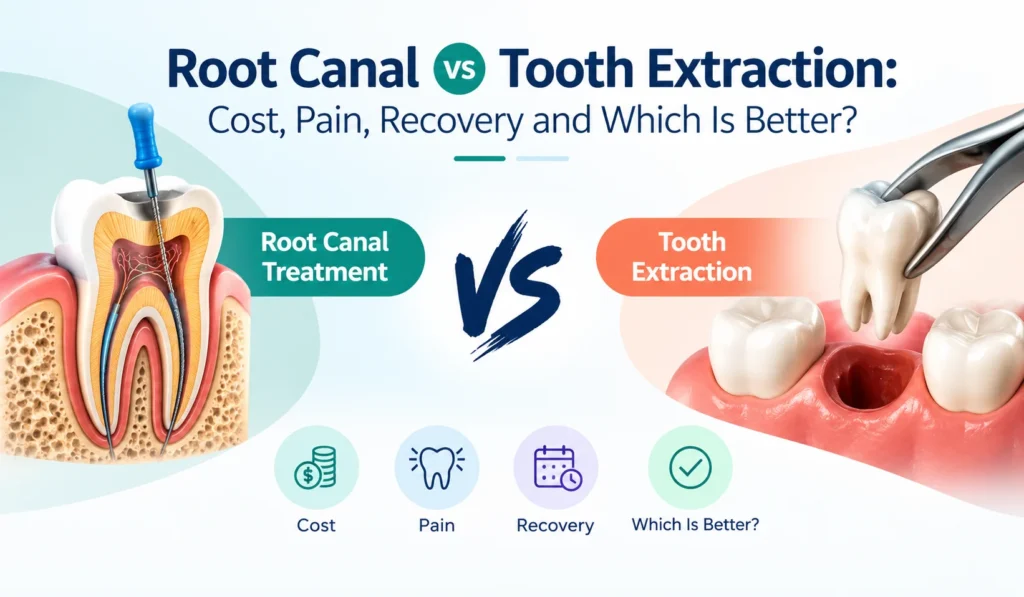
A painful, badly decayed, infected, or broken tooth can leave you with one stressful question: Should you save the tooth with a root canal or have it removed?
The answer is not the same for everyone.
In some cases, a root canal can treat infection while preserving the natural tooth. In other situations, the tooth may be too damaged or difficult to restore, making extraction the more practical option. The decision depends on the condition of the tooth, the surrounding gums and bone, the amount of healthy tooth structure remaining, and whether the tooth can be predictably restored.
At DantYug Dental Clinic, the focus is on understanding the condition of the tooth before deciding whether root canal treatment or extraction is the more suitable option.
So, which is better, root canal or tooth extraction? The right choice is usually the treatment that gives the tooth and your overall oral health the best long-term outcome.
Root Canal vs Tooth Extraction at a Glance
| Factor | Root Canal Treatment | Tooth Extraction |
|---|---|---|
| Main goal | Treat the infected or damaged inside of the tooth and preserve it | Remove a tooth that cannot be predictably restored |
| Natural tooth | Preserved | Removed |
| Infection inside tooth | Treated by cleaning and sealing the canals | Source of infection is removed with the tooth |
| Treatment comfort | Local anaesthesia is used | Local anaesthesia is used |
| Recovery | Usually involves temporary tenderness | Involves healing of the extraction socket |
| Final restoration | A filling or crown may be needed | Replacement may be needed depending on the tooth |
| Long-term planning | Focuses on keeping the natural tooth | May involve an implant, bridge, or denture |
The comparison is simple, but the decision behind it can be more complicated. A dentist needs to determine whether the tooth is still restorable before recommending either option.
What Is a Root Canal Treatment?
A root canal is a treatment used when the pulp, or soft tissue inside a tooth, becomes inflamed or infected.
This can happen because of deep decay, repeated dental procedures, cracks, trauma, or other damage to the tooth.
During root canal treatment, the dentist removes the diseased pulp, cleans and disinfects the inside of the tooth, fills and seals the root canals, and then restores the tooth so it can function again. The aim is to save the natural tooth rather than remove it.
What happens during a root canal?
The exact steps depend on the tooth and the complexity of the case, but treatment generally involves:
- Numbing the area with local anaesthesia.
- Creating access to the inside of the tooth.
- Removing infected or damaged pulp.
- Cleaning and disinfecting the root canals.
- Filling and sealing the canals.
- Restoring the tooth with an appropriate filling or crown when needed.
A root canal is not simply about stopping pain. It is about treating the source of the problem while maintaining the tooth in your mouth.
When Might You Need a Root Canal?
A dentist may consider root canal treatment when the tooth is infected or the pulp is significantly damaged but the tooth can still be restored.
Possible signs include:
- Persistent or severe toothache
- Pain while biting or chewing
- Prolonged sensitivity to hot or cold
- Swelling around the tooth
- A recurring dental abscess
- Deep tooth decay
- A cracked or damaged tooth affecting the pulp
- Tooth damage following an injury
Not every painful tooth needs a root canal, and not every root canal starts with severe pain. A proper dental examination is important because symptoms alone cannot tell you whether a tooth can be saved.
What Is Tooth Extraction?
Tooth extraction means removing the tooth from its socket when it cannot be adequately maintained or restored.
Extraction can sometimes be the appropriate choice for a tooth with severe structural damage, extensive decay, certain fractures, or other conditions where predictable restoration is no longer possible.
While removing the tooth may solve the immediate problem, it also creates a missing-tooth space. Depending on the tooth and your overall bite, your dentist may discuss replacement options such as an implant, bridge, or denture.
What happens after tooth extraction?
After an extraction, the socket needs time to heal. Your dentist may provide advice about food, brushing, activity, and follow-up care.
The treatment plan should not always stop at “remove the tooth.” It is also worth discussing what happens next, especially if the missing tooth affects chewing, appearance, or the position of nearby teeth.
Root Canal vs Tooth Extraction: Which Is Better?
This is the question most patients want answered.
A root canal may be a better option when the tooth can be saved
When sufficient healthy tooth structure remains and the tooth can be restored predictably, preserving the natural tooth can have important functional advantages.
Keeping the natural tooth may help you maintain your normal bite and chewing function without immediately needing a replacement tooth.
Extraction may be better when the tooth cannot be predictably restored
There are situations where keeping the tooth is not realistic.
For example, the tooth may have extensive structural damage, severe decay, or a fracture that makes restoration unreliable. In such cases, extracting the tooth and planning an appropriate replacement may be a more suitable long-term approach.
The important point is this:
The goal is not to choose root canal treatment at any cost. The goal is to choose the treatment that gives you the most predictable outcome.
Pros and Cons of Root Canal Treatment
Pros of a Root Canal
Preserves the natural tooth
The biggest advantage is that the tooth remains in your mouth.
Helps treat infection inside the tooth
The infected or inflamed pulp is removed, and the canals are cleaned and sealed.
Maintains natural chewing function
A properly restored natural tooth can continue to contribute to normal chewing.
May avoid immediate tooth replacement
If the natural tooth is successfully maintained, you may not need an implant, bridge, or denture simply because the tooth was removed.
Cons of a Root Canal
The tooth still needs restoration
Depending on the tooth and how much structure remains, a crown or other restoration may be recommended.
Treatment can be more involved
Complex teeth may require additional appointments or specialist assessment.
The tooth may not always be savable
A root canal cannot make an unrestorable tooth restorable.
Retreatment may occasionally be needed
Like other dental treatments, root canal treatment is not a guarantee that the tooth will never have another problem.
Pros and Cons of Tooth Extraction
Pros of Tooth Extraction
Removes a severely damaged tooth
When a tooth cannot be predictably restored, extraction may provide a practical treatment solution.
Removes the source of infection in the tooth
The affected tooth itself is removed.
Can be appropriate when preservation is not possible
Some teeth simply cannot be restored successfully.
Cons of Tooth Extraction
You lose the natural tooth
Once removed, the tooth cannot be returned.
A missing tooth may affect function
Depending on its position, tooth loss can affect chewing.
Replacement may be required
An implant, bridge, or denture may be considered depending on the situation.
Long-term planning matters
Leaving a missing tooth without discussing replacement may not be ideal for every patient.
Is a Root Canal More Painful Than Tooth Extraction?
This is one of the biggest concerns patients have before treatment.
With modern local anaesthesia, dentists aim to keep both procedures comfortable during treatment. You may still experience pressure, movement, or some sensation, but sharp pain during treatment should be addressed with appropriate anaesthesia.
After treatment, some tenderness or discomfort can occur with either procedure. The amount varies according to the condition of the tooth, the complexity of the treatment, and your individual response.
So, is root canal treatment more painful than tooth extraction? There is no universal answer. What matters is treating the underlying dental problem properly and following your dentist’s aftercare instructions.
Root Canal vs Tooth Extraction Cost
Cost is another major factor, but comparing only the first procedure can be misleading.
A root canal may involve:
- The root canal procedure
- A final filling or crown
- Follow-up care
An extraction may involve:
- The extraction procedure
- Follow-up care
- A dental implant, bridge, or denture if replacement is recommended
This means an extraction can appear less expensive initially but involve additional treatment later.
The actual root canal vs tooth extraction cost depends on the tooth, the complexity of the case, the condition of the surrounding tissues, and the restoration or replacement required.
For that reason, ask your dentist about the complete treatment plan and expected long-term costs, rather than comparing only the first appointment.
Root Canal vs Tooth Extraction Recovery
Recovery after a root canal
After root canal treatment, you may experience temporary tenderness or sensitivity around the treated tooth. Your dentist may also recommend avoiding heavy chewing on the tooth until the final restoration is completed, when applicable.
Recovery after extraction
Extraction recovery involves healing of the socket. You may experience soreness or swelling, and your dentist may recommend temporary changes to your diet and oral care routine.
The recovery period is different for every patient, so your dentist’s personalised aftercare instructions should take priority.
Root Canal vs Extraction for a Cracked Tooth
A cracked tooth needs careful assessment because not every cracked tooth requires extraction.
The important questions include:
- Where is the crack?
- How deep is it?
- Does it involve the pulp?
- How much healthy tooth structure remains?
- Can the tooth be properly restored?
Some cracked teeth can still be treated with root canal therapy followed by appropriate restoration. However, a crack extending below the gumline can make a tooth difficult or impossible to save predictably.
This is why simply searching for “cracked tooth extraction” and deciding on treatment yourself is not recommended.
Do You Need a Crown After a Root Canal?
Not every tooth has exactly the same restoration requirement.
After a root canal, the dentist evaluates how much tooth structure remains and how much chewing force the tooth receives. A crown or another suitable restoration may be recommended to protect the tooth and restore its function.
This is especially important when a tooth has already lost a significant amount of structure through decay, cracks, or previous dental work. Appropriate final restoration is an important part of protecting the treated tooth.
What Happens If You Extract a Tooth Instead of Saving It?
If extraction is the right treatment, your dentist may also discuss what should happen after the tooth is removed.
Depending on your situation, replacement options can include:
Dental Implant
A dental implant can replace a missing tooth by providing a stable foundation for a replacement crown. It can help restore chewing function and appearance while providing a fixed replacement option. Whether an implant is suitable depends on factors such as bone condition, gum health, overall oral health, and the location of the missing tooth.
Dental Bridge
A dental bridge can replace a missing tooth by using support from neighbouring teeth or other appropriate structures. It can restore chewing ability and help fill the visible space created by extraction. Your dentist will evaluate the condition of surrounding teeth, your bite, gum health, and overall oral condition before recommending a bridge.
Denture
A removable partial denture may be considered when one or more teeth are missing. It can help restore chewing function and improve appearance while offering a removable replacement option. The design depends on the number and location of missing teeth, the condition of supporting teeth and gums, and your individual dental needs.
How Does a Dentist Decide Between Root Canal and Extraction?
This is where professional diagnosis matters most.
Your dentist may consider:
- Your symptoms and dental history
- The amount of remaining healthy tooth structure
- The extent of decay or infection
- Cracks or fractures
- Gum and bone support
- Findings from dental X-rays or other appropriate imaging
- Whether the tooth can be predictably restored
- Your long-term dental goals
A tooth should not be extracted simply because it hurts, and a root canal should not be recommended simply because the tooth is technically treatable.
The key question is:
Can this tooth be predictably restored and maintained?
If yes, preserving the natural tooth may be worth considering. If not, extraction and appropriate replacement planning may be the more practical route.
Root Canal or Tooth Extraction for Common Dental Problems
Deep Tooth Decay
Deep tooth decay can spread through the outer layers of a tooth and eventually affect the pulp. If enough healthy tooth structure remains, root canal treatment may help remove the infection and preserve the tooth. If the tooth is too extensively damaged to restore, extraction may be considered instead.
Dental Abscess
A dental abscess can develop when bacteria infect the inside of a tooth or surrounding tissues. Treatment depends on the source and condition of the affected tooth. If the tooth can be restored, root canal treatment may be considered. If it cannot be predictably saved, extraction may be recommended by the dentist.
Broken Tooth
A broken tooth can range from a small fracture to significant structural damage. The dentist will assess how much healthy tooth structure remains, whether the pulp is affected, and whether the tooth can be restored. Depending on these findings, treatment may include root canal therapy, restoration, or extraction.
Cracked Tooth
Not every cracked tooth needs to be extracted. Treatment depends on the location, depth, direction, and extent of the crack, as well as the condition of the remaining tooth structure. Some cracks involving the pulp may be treated with root canal therapy and restoration, while severe cracks may require extraction.
Severe Tooth Pain
Severe tooth pain can have several causes, including deep decay, pulp inflammation, infection, cracks, or other dental problems. Pain alone does not determine whether you need a root canal or extraction. A dental examination and appropriate imaging can help identify the cause and determine the most suitable treatment.
Previously Treated Tooth
A tooth that has already received root canal treatment may develop symptoms again for several reasons. Further evaluation can help identify the cause. Depending on the condition of the tooth, options may include retreatment or other restorative procedures. Extraction may be considered when the tooth cannot be predictably maintained.
Can You Avoid Tooth Extraction With a Root Canal?
Sometimes, yes.
If the tooth is infected but still has enough healthy structure to be restored and maintained, a root canal may offer an opportunity to preserve it.
However, root canal treatment cannot save every tooth.
A tooth that has severe structural damage or is not predictably restorable may still require extraction.
That is why a dental examination is more useful than trying to decide based only on online symptoms.
Root Canal and Tooth Extraction in Bhugaon and Pune
When you are searching for root canal treatment in Bhugaon, tooth extraction in Bhugaon, or a root canal dentist in Pune, it is important to choose a clinic where the focus is on diagnosis and appropriate treatment planning rather than automatically recommending one procedure.
For patients looking for a Best Dental Clinic in Bhugaon, the priority should be clear diagnosis, transparent treatment discussions, and care based on the actual condition of the tooth.
At DantYug Dental Clinic, patients can discuss their symptoms, dental reports and treatment options with the dental team and understand why a particular treatment may be recommended.
Whether the treatment involves root canal therapy, extraction, or tooth replacement, the goal should be to make an informed decision based on the condition of your tooth and your long-term oral health.
When Should You See a Dentist?
Do not wait too long if you have:
- Severe or persistent tooth pain
- Pain when biting or chewing
- Prolonged sensitivity to hot or cold
- Swelling around the tooth or gums
- A recurring gum pimple or discharge
- A broken or cracked tooth
- Facial swelling
- Worsening dental pain with fever
Some dental infections can worsen without timely treatment, so an evaluation is important when symptoms persist or become more severe.
Frequently Asked Questions
Is a root canal better than tooth extraction?
A root canal may be a better option when the natural tooth has enough healthy structure to be restored and maintained. It allows the tooth to remain in place while treating infection or damaged pulp. Extraction may be more appropriate when the tooth is severely damaged, fractured, or cannot be predictably restored. The right choice depends on the condition of the tooth, surrounding tissues, and long-term treatment goals. A dental examination and appropriate imaging can help determine which option is suitable.
Which is more painful, a root canal or tooth extraction?
Both root canal treatment and tooth extraction are generally performed using local anaesthesia to keep the procedure comfortable. You may experience pressure or movement during treatment rather than sharp pain. Some tenderness, sensitivity, or soreness can occur afterward with either procedure. The level of discomfort varies depending on the condition of the tooth, the complexity of treatment, and individual sensitivity. Your dentist can also provide specific aftercare advice to help manage discomfort during recovery.
Is tooth extraction cheaper than root canal treatment?
The initial cost of tooth extraction may sometimes be lower than root canal treatment, but the overall treatment cost can be different. If a tooth is extracted, you may later need an implant, bridge, or denture to replace it. Root canal treatment may also require a final restoration, such as a crown. Therefore, it is better to compare the complete treatment plan, including follow-up care and possible replacement needs, instead of looking only at the first procedure.
Can an infected tooth be saved with a root canal?
In some cases, an infected tooth can be saved with root canal treatment if enough healthy tooth structure remains and the tooth can be predictably restored. The treatment involves removing infected or inflamed pulp, cleaning the root canals, and sealing them. However, root canal treatment cannot save every tooth. Severe structural damage, certain fractures, or insufficient remaining tooth structure may make extraction a more appropriate option. A dentist can assess the tooth before recommending treatment.
When is extraction better than root canal?
Tooth extraction may be considered when a tooth has extensive decay, severe structural damage, certain fractures, or too little healthy structure for predictable restoration. It may also be appropriate when other factors make maintaining the tooth unreliable. However, pain alone does not determine whether extraction is necessary. A dentist should evaluate the tooth, surrounding gums and bone, and available treatment options before making a recommendation. The goal is to choose the treatment with the most predictable long-term result.
How long does a root canal take?
The time required for a root canal depends on several factors, including which tooth is being treated, the number and shape of its canals, the extent of infection, and the complexity of the case. Some treatments can be completed in one appointment, while others may require additional visits. The final restoration, such as a filling or crown, may also require a separate appointment. Your dentist can provide a more accurate estimate after examining the tooth.
How long does tooth extraction take to heal?
Healing after tooth extraction varies depending on the type of extraction, the location of the tooth, the surrounding tissues, and your general health. Initial soreness or swelling may occur after the procedure and generally improves as healing progresses. The extraction socket continues to heal over time, so following your dentist’s instructions is important. Aftercare may include recommendations about food, oral hygiene, physical activity, and follow-up appointments. Your dentist can explain the expected healing process for your specific extraction.
Does every root canal need a crown?
Not every tooth automatically needs a crown after root canal treatment. The recommended restoration depends on the type of tooth, the amount of healthy tooth structure remaining, previous restorations, and the forces the tooth experiences during chewing. Back teeth often experience greater chewing pressure and may require stronger protection, while other situations may be managed differently. Your dentist will evaluate the treated tooth and recommend a suitable final restoration based on its condition and long-term needs.
Can a cracked tooth be saved with a root canal?
Some cracked teeth may be treated with root canal therapy when the tooth has enough healthy structure and the crack can be managed with appropriate restoration. However, the outcome depends heavily on the location, direction, and depth of the crack. A crack that extends into an area where the tooth cannot be predictably restored may require extraction. Because cracks are not always visible from the outside, a dental examination and appropriate imaging are important before deciding on treatment.
What happens if I do not replace an extracted tooth?
The effect of leaving an extracted tooth unreplaced depends on its location and your individual bite. A missing tooth can affect chewing and, in some situations, may allow neighbouring teeth to shift over time. Your dentist can assess whether replacement is recommended based on the tooth that was removed and your overall oral health. When replacement is appropriate, options may include a dental implant, bridge, or partial denture, depending on your needs and suitability.
Should I get a second opinion before tooth extraction?
Getting a second opinion can be helpful when a tooth is being considered for permanent removal, particularly if you are unsure whether it can be restored. Another qualified dentist can review your symptoms, examination findings, and dental imaging and explain the available options. A second opinion does not necessarily change the treatment recommendation, but it can give you greater clarity about the benefits, limitations, risks, and long-term considerations of root canal treatment compared with extraction.
Root Canal vs Extraction: The Right Choice for You
So, root canal vs tooth extraction: which is better?
There is no single answer that applies to every tooth.
When a tooth is infected or damaged but can still be predictably restored, root canal treatment may allow you to keep your natural tooth. When the tooth is too severely damaged or cannot be reliably restored, extraction may be the more appropriate choice.
The best decision is not simply about choosing the cheaper, faster, or less intimidating option. It is about understanding the condition of your tooth and choosing a treatment plan that supports your oral health in the long term.
If you are experiencing tooth pain, swelling, sensitivity, a broken tooth, or have been advised to get an extraction, DantYug Dental Clinic can help you understand whether root canal treatment or tooth extraction is appropriate for your case.
Consult DantYug Dental Clinic for an evaluation and discuss the most suitable treatment option for your tooth.